Pet Food Bag 3D Mockup Evaluation Guide
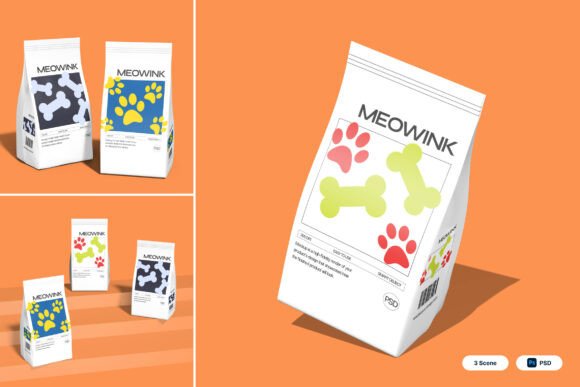
In the competitive landscape of pet nutrition and veterinary merchandise, visual presentation plays a critical role in consumer decision-making. A Pet Food Bag 3D Mockup serves as a digital tool designed to visualize packaging concepts before physical production begins. This specific resource features a realistic standing pouch design with detailed product label areas and customizable branding surfaces. It is engineered to assist designers, brand managers, and marketers in presenting cat and dog food products, animal nutrition campaigns, and ecommerce showcases with professional fidelity. Understanding the capabilities, limitations, and appropriate use cases of this asset is essential for determining its value within a specific workflow.
Understanding the Asset and Its Function
A Pet Food Bag 3D Mockup is not merely an image file; it is a functional template built for rapid prototyping. The core structure typically consists of high-resolution PSD files that utilize smart object layers. This technical feature allows users to double-click a designated layer, insert their own design artwork, and save the file to automatically render the new design onto the three-dimensional surface of the bag. The resulting output maintains realistic lighting, shadows, and texture, simulating how the final printed package will appear on a shelf or in a digital catalog.
The specific mockup described here includes three distinct variations, offering flexibility for different presentation angles or color schemes. With a resolution of 4000 x 3000 pixels at 300 dpi, the output quality meets industry standards for both high-quality web display and print-ready materials. The inclusion of a PDF help guide ensures that users can navigate the smart object functionality without requiring advanced 3D modeling skills. It is important to note that while the packaging structure is provided, any stock imagery placed inside the design area by the user is not included in the base download and must be sourced separately.
Reasons for Interest and Primary Use Cases
Professionals often seek a realistic pet food bag 3D mockup to bridge the gap between flat graphic design and tangible product reality. For brands launching new lines of cat or dog food, the ability to visualize the packaging in a standing pouch format is crucial. Standing pouches are increasingly popular in the pet food industry due to their resealability and cost-effectiveness compared to rigid containers. Evaluating a design on a flat screen can lead to misjudgments regarding typography readability, logo placement, and overall aesthetic balance.
This tool is particularly valuable for several specific scenarios:
- Ecommerce Showcases: Online retailers require high-quality images that convey texture and volume to compensate for the lack of physical interaction. A 3D rendering provides depth cues that flat JPEGs cannot.
- Veterinary Merchandise: Clinics and vet supply stores often need promotional materials for private-label supplements or treats. Consistent branding across these items requires precise visualization.
- Pet Shop Promotions: Marketing teams creating flyers, social media ads, or in-store displays need assets that look authentic to build consumer trust.
- Animal Nutrition Campaigns: Educational content often benefits from realistic product visuals to demonstrate serving sizes or ingredient highlights effectively.
Benefits and Workflow Advantages
The primary advantage of utilizing a Pet Food Bag 3D Mockup lies in efficiency and cost reduction. Traditional prototyping involves printing physical samples, which incurs material costs, shipping fees, and significant time delays. By using a digital mockup, designers can iterate through dozens of design variations in minutes. If a client requests a change in font size or a shift in color palette, the adjustment can be made instantly via the smart object layer without needing to re-render a complex 3D scene from scratch.
Furthermore, the high resolution (300 dpi) ensures that the mockup remains sharp when zoomed in or printed for large-format marketing collateral. The inclusion of multiple PSD files allows for A/B testing of different background environments or lighting conditions without altering the core design. This flexibility supports a more dynamic creative process, enabling teams to present options that better align with brand identity and market positioning.
Tradeoffs and Considerations
While highly effective, this type of asset is not without limitations. The most significant tradeoff is the static nature of the perspective. Unlike fully rendered 3D software where a model can be rotated infinitely, a mockup file is fixed to specific angles. If a project requires a unique viewpoint not covered by the three included files, the user may find the asset restrictive.
Additionally, the realism of the final image depends heavily on the quality of the input design. The smart object technology maps the 2D artwork onto a curved surface, but it cannot perfectly simulate complex material interactions like metallic foils, embossing, or matte varnishes unless those effects are pre-applied to the artwork itself. Users must also be aware that the stock images inside the mockup are placeholders. Replacing these with proprietary photography requires careful attention to lighting and perspective to maintain the illusion of realism.
Situations Where Alternatives May Be Worth Considering
Although the Pet Food Bag 3D Mockup is robust for standard presentations, there are scenarios where other solutions might be more appropriate. If a project demands photorealistic animation for video advertising, a static PSD file will not suffice. In such cases, dedicated 3D modeling software or motion graphics tools are necessary to create rotating views and dynamic interactions.
Similarly, if the packaging geometry is non-standard—such as a uniquely shaped container or a multi-compartment pouch—a generic standing pouch mockup will not fit the requirements. Custom 3D modeling would be required to accurately represent the specific structural nuances of the product. Finally, for clients who need absolute precision in color matching for print production, relying solely on a digital mockup carries risks. While the mockup helps visualize layout, it should never replace a physical proof for final color approval, as screen calibration varies significantly from print output.
Practical Decision-Making Insights
To determine if this asset aligns with your goals, consider the stage of your project and your technical resources. If you are in the concept phase, seeking stakeholder approval, or preparing marketing materials for digital channels, the Pet Food Bag 3D Mockup offers an excellent balance of speed and quality. The ease of use provided by the smart object layers makes it accessible even for those with intermediate Photoshop skills, reducing the barrier to entry for high-quality visualization.
However, if your workflow requires extensive customization of the packaging shape or integration into a larger 3D environment, investing time in learning full 3D rendering software may yield better long-term results. Evaluate whether the three included variations cover the necessary angles for your campaign. If they do, the mockup is a cost-effective solution that eliminates the need for expensive photo shoots during the development phase. Ultimately, the value of this tool lies in its ability to accelerate the design-to-presentation cycle while maintaining a professional aesthetic suitable for the diverse needs of the pet product industry.