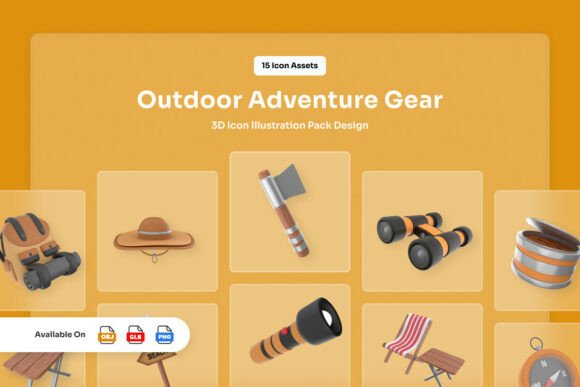
Elevating Outdoor Narratives with Camping Hiking Gear 3D Icons
In the rapidly evolving landscape of digital design, the representation of outdoor activities has shifted dramatically from flat, two-dimensional illustrations to immersive, three-dimensional assets. This transition is not merely an aesthetic preference but a strategic move to capture user attention in an increasingly saturated digital environment. At the forefront of this shift are specialized asset packs like Camping Hiking Gear 3D Icons, which offer a unique blend of playfulness, modernity, and functional clarity. These assets are designed to bridge the gap between technical precision and artistic expression, providing creators with a toolkit that enhances storytelling across various platforms.
The appeal of these specific icons lies in their ability to convey complex ideas about nature and adventure through simplified yet expressive shapes. Unlike traditional clip art or rigid vector graphics, these 3D elements possess depth, lighting, and texture that make them instantly recognizable and engaging. Whether used in a mobile application interface, a marketing campaign for an outdoor brand, or an educational module on wilderness survival, these icons serve as visual anchors that guide the user's experience. The clean visual approach ensures that they do not overwhelm the content but rather complement it, creating a light and inviting atmosphere that encourages interaction.
The Evolution of Visual Language in Outdoor Design
To understand the significance of modern 3D icon sets, one must first look at the history of how outdoor gear was depicted digitally. For decades, the standard was the flat icon: simple outlines of tents, backpacks, and boots rendered in single colors. While effective for basic navigation, these designs often lacked personality and failed to evoke the tactile sensation of the outdoors. As screen resolutions improved and rendering engines became more accessible, designers began experimenting with depth and shading.
The introduction of Camping Hiking Gear 3D Icons represents a maturation of this trend. These assets move beyond mere realism into a stylized realm where form follows function with a touch of whimsy. The "playful" aspect mentioned in their description is crucial; it lowers the barrier to entry for users who might feel intimidated by the ruggedness of actual hiking. By presenting gear in a friendly, approachable manner, these icons democratize the concept of outdoor exploration. They suggest that adventure is not just for the elite mountaineer but for anyone willing to step outside.
This evolution aligns with broader trends in UI/UX design, where soft shadows, rounded edges, and vibrant gradients have become the norm. The 3D nature of these icons allows them to react dynamically to different lighting conditions within a digital interface, adding a layer of interactivity that flat images cannot match. For professionals working in branding, this means a more versatile toolkit that can adapt to various moods and contexts without losing its core identity.
Technical Specifications and Workflow Integration
For designers and developers, the utility of an asset pack is defined not just by its look but by its flexibility and ease of integration. The Camping Hiking Gear 3D Icons set is engineered to streamline workflows for professionals using industry-standard software. The inclusion of fully editable color options in Blender is a significant advantage. It allows artists to customize the palette of each icon to match specific brand guidelines without needing to reconstruct the geometry from scratch.
The organization of the files plays a critical role in efficiency. With well-organized layers, users can isolate specific components of the gear—such as the straps of a backpack or the poles of a tent—for detailed modification. This level of granularity is essential for high-end projects where every pixel counts. Furthermore, the provision of multiple file formats ensures compatibility across diverse ecosystems:
- Blender Files (.BLEND): Ideal for 3D artists who need to manipulate geometry, materials, and lighting directly within the source environment.
- OBJ Files: A universal format that facilitates easy import into other 3D modeling software like Maya, 3ds Max, or Cinema 4D.
- GLB Files: Optimized for web and mobile applications, allowing for real-time rendering of 3D assets in browsers and AR environments.
- PNG Files (3000 x 3000 px): High-resolution static images with transparent backgrounds, ready for immediate use in print, social media, and non-interactive digital layouts.
This multi-format approach eliminates the friction often associated with asset conversion. A marketing team can use the PNGs for an email newsletter while the development team simultaneously integrates the GLB files into an interactive product configurator. Such versatility makes these icons a cost-effective solution for businesses looking to maintain visual consistency across all touchpoints.
Strategic Applications Across Industries
The versatility of these 3D assets extends far beyond simple decoration. They serve as functional tools in various sectors, enhancing communication and engagement in ways that text alone cannot achieve. Understanding where and how to deploy Camping Hiking Gear 3D Icons can transform a standard project into a standout experience.
Branding and Marketing for Outdoor Enterprises
For companies selling outdoor equipment, apparel, or services, visual identity is paramount. Traditional photography can be expensive and sometimes lacks the clarity needed to highlight specific features of a product. 3D icons offer a stylized alternative that can be used to create cohesive brand systems. Imagine a website where every category—from tents to water filtration systems—is represented by a consistent set of playful, 3D-rendered icons. This creates a memorable visual language that reinforces the brand's commitment to quality and fun.
Moreover, these icons are excellent for social media campaigns. In an era where scroll speed is high, the depth and dimensionality of 3D assets help posts stand out in crowded feeds. They can be animated easily to show movement, such as a tent being pitched or a backpack zipping shut, capturing attention and driving engagement metrics higher than static imagery.
Digital Content and Educational Platforms
Education is another sector that benefits immensely from clear, engaging visuals. When teaching children or beginners about camping safety or hiking preparation, abstract concepts can be difficult to grasp. Using Camping Hiking Gear 3D Icons helps visualize these concepts concretely. An educational app could use these icons to gamify the learning process, asking users to drag the correct gear into a virtual backpack before a trip.
The "clean and modern" aesthetic ensures that the content feels current and appealing to younger audiences, who are often accustomed to high-quality graphics in gaming and entertainment. Educators can also use the high-resolution PNGs in presentations and printed materials, ensuring that the visuals remain sharp and legible regardless of the medium.
User Interface and Experience Design
In the realm of app development, particularly for travel, fitness, and outdoor planning applications, these icons serve as intuitive navigational aids. Users scanning an app for information rely on visual cues to find what they need quickly. A 3D icon of a compass or a map is instantly recognizable, reducing cognitive load and improving the overall user experience. The transparency of the PNG files allows these icons to sit seamlessly over various background colors and textures, maintaining readability and aesthetic harmony.
Design Principles Behind the Aesthetic
The success of this particular icon set is rooted in specific design principles that prioritize usability and emotional connection. The decision to use simplified shapes is not arbitrary; it is a response to the need for scalability. Complex details often get lost when icons are scaled down for mobile screens or favicon sizes. By stripping away unnecessary intricacies while retaining the essence of the object, these icons remain legible at any size.
The "expressive" quality of the shapes adds a layer of personality. A hiking boot isn't just a shoe; it's a symbol of journey and endurance. A tent isn't just shelter; it's a promise of rest and community. The 3D rendering technique enhances this by adding volume and weight, making the objects feel tangible. This tactile quality is particularly important in the context of outdoor gear, where the physical attributes of the items are central to their function.
Furthermore, the flexible integration capability means that these icons can be adapted to different design concepts without losing their core identity. They can be placed in minimalist interfaces for a sleek look or surrounded by lush, natural backgrounds for a more organic feel. This adaptability is key for designers working on long-term projects where the visual direction may evolve over time.
Considerations for Implementation
While the benefits of using Camping Hiking Gear 3D Icons are substantial, there are considerations to keep in mind during implementation. Lighting and shadow consistency are critical when integrating 3D assets into a scene. If the icons are sourced as static PNGs, the designer must ensure that the lighting angle matches the rest of the interface to avoid a disjointed look. However, if using the editable Blender or GLB files, dynamic lighting can be applied to ensure perfect integration.
Performance is another factor, especially for web and mobile applications. While the GLB files are optimized, loading too many high-poly 3D assets simultaneously can impact page load times. It is advisable to use the PNG versions for static elements and reserve the interactive 3D models for areas where user engagement is highest. Balancing visual fidelity with performance ensures a smooth experience for the end-user.
Future Trends in Outdoor Digital Visualization
Looking ahead, the demand for high-quality, customizable 3D assets in the outdoor sector is poised to grow. As augmented reality (AR) and virtual reality (VR) technologies become more mainstream, the ability to interact with digital representations of physical gear will become standard. The Camping Hiking Gear 3D Icons set is well-positioned to meet this future demand, offering a foundation upon which immersive experiences can be built.
We can expect to see these types of assets used in virtual try-on experiences, where users can see how a backpack fits or how a tent looks in a virtual campsite. The playful and modern style will continue to resonate with consumers who value both functionality and aesthetics in their outdoor gear choices. As the line between digital and physical experiences blurs, having a robust library of 3D icons will be essential for brands aiming to stay relevant and engaging.
Ultimately, the value of these icons lies in their ability to tell a story. They transform the mundane task of selecting gear into an exciting prelude to adventure. By combining technical excellence with artistic flair, they provide a powerful tool for anyone looking to bring the spirit of the outdoors into the digital world. Whether for a seasoned professional or a hobbyist starting their first project, these assets offer a pathway to creating visuals that are not only seen but felt.