Mastering Adhesive Branding with the Sticker Tape 3D Mockup
In the competitive landscape of visual marketing, the ability to present packaging concepts with photorealistic accuracy is no longer a luxury; it is a fundamental requirement for success. Whether you are designing shipping labels for an e-commerce giant or creating custom warning tape for industrial safety, the presentation of your design dictates how seriously it is taken by stakeholders. This is where specialized visualization tools become indispensable. The Sticker Tape 3D Mockup offers a sophisticated solution for designers who need to showcase bold branding layouts on realistic adhesive tape rolls. By bridging the gap between flat digital art and tangible product perception, this tool transforms simple vector graphics into compelling, three-dimensional narratives.
The Evolution of Packaging Visualization
Historically, presenting tape and adhesive products in a portfolio required expensive photography sessions. Designers had to source physical materials, apply their designs manually, set up lighting rigs, and spend hours capturing the perfect angle. Even then, the results were often limited by the constraints of the physical world—wrinkles, uneven lighting, or imperfect adhesion could ruin a shot. Today, the workflow has shifted dramatically toward digital precision. High-quality mockups allow creators to iterate instantly, testing different colorways, textures, and compositions without ever leaving their workstation.
The Sticker Tape 3D Mockup represents the pinnacle of this evolution. It moves beyond simple flat overlays to provide a dynamic environment that simulates the physics of light and material. When a client views a design on a glossy tape roll with accurate reflections and shadows, they are not just seeing a logo; they are visualizing the final product on a shelf or in a warehouse. This level of realism builds trust and accelerates the approval process, making it an essential asset for professionals across various industries.
Anatomy of Realism: Material and Light
What distinguishes a professional-grade mockup from a generic template is the attention paid to material properties. Adhesive tape is unique because it combines flexibility with a specific surface finish that interacts with light in complex ways. A standard paper texture will not suffice. The Sticker Tape 3D Mockup presents realistic adhesive tape rolls featuring glossy material textures that mimic the sheen of plastic or vinyl substrates commonly used in commercial applications.
Lighting plays a crucial role in establishing this realism. The mockup utilizes clean shadows and detailed surface reflections to ground the object in space. When light hits a curved tape roll, it creates specular highlights that define the roundness and smoothness of the cylinder. These highlights must be positioned correctly relative to the light source to maintain believability. Furthermore, the way the tape wraps around the core requires careful handling of perspective distortion. If the text or graphics do not wrap naturally, the illusion breaks immediately. The included files handle these complexities automatically, ensuring that the design conforms perfectly to the curvature of the roll, whether it is stacked, unrolled, or floating in a void.
Diverse Perspectives for Comprehensive Storytelling
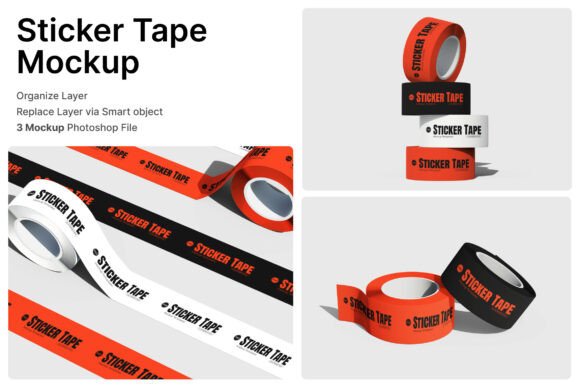
A single image rarely tells the whole story of a product. To fully appreciate the versatility of a tape design, viewers need to see it from multiple angles and in different states of use. The Sticker Tape 3D Mockup features multiple tape perspectives including stacked rolls, unrolled strips, and floating arrangements. Each perspective serves a distinct purpose in the design narrative.
- Stacked Rolls: This composition suggests volume, inventory, and industrial scale. It is ideal for showcasing warehouse branding or bulk shipping solutions. Seeing multiple rolls stacked implies reliability and mass production capabilities.
- Unrolled Strips: An unrolled strip demonstrates the continuity of the pattern and the clarity of the print over a linear distance. This is particularly useful for warning tape or promotional ribbons where the message repeats along the length of the material.
- Floating Arrangements: Isolating a roll against a clean background removes distractions and focuses entirely on the branding details. This style is excellent for retail packaging presentations where the product needs to stand out on a digital storefront.
Practical Applications Across Industries
The utility of a high-fidelity tape mockup extends far beyond graphic design portfolios. It serves as a critical communication tool for businesses operating in logistics, retail, safety, and marketing. By leveraging the Sticker Tape 3D Mockup, organizations can prototype their visual identity before committing to costly manufacturing runs.
Logistics and Shipping Solutions
In the world of e-commerce and logistics, the shipping box is often the first physical touchpoint a customer has with a brand. Custom adhesive branding on shipping tape turns a mundane necessity into a powerful marketing opportunity. Before investing in thousands of feet of printed tape, companies can use the mockup to visualize how their logo looks when sealing a package. They can test contrast ratios to ensure readability under varying lighting conditions in a distribution center. The mockup allows for the simulation of how the tape stretches and adheres, providing a realistic preview of the end-user experience.
Retail and Promotional Displays
Retail environments rely heavily on visual cues to guide consumer behavior. Promotional product presentations often utilize tape to mark sales areas, create floor guides, or seal special edition packaging. The Sticker Tape 3D Mockup enables marketers to experiment with bold colors and aggressive typography that might be difficult to visualize on a screen alone. By seeing the design rendered with glossy textures, retailers can assess whether the tape will catch the eye of a passerby in a busy store aisle. This capability reduces the risk of launching a campaign with ineffective visuals.
Safety and Industrial Warning Systems
For industrial applications, clarity and compliance are paramount. Warning tape must be instantly recognizable and legible. Designers working on safety protocols can use the mockup to verify that hazard symbols and caution text remain clear even when the tape is stretched or viewed from an angle. The realistic rendering helps safety officers understand how the tape will perform in real-world scenarios, such as dimly lit warehouses or outdoor construction sites. The ability to simulate different environmental lighting through the mockup's reflection layers adds another layer of validation to the design process.
Streamlining the Design Workflow
Efficiency is a key driver for adopting advanced mockup tools. The Sticker Tape 3D Mockup is engineered to integrate seamlessly into existing Adobe Photoshop workflows. The feature set includes Smart Object layers, which simplify the process of inserting custom designs. Users simply double-click the layer, place their artwork, and save. The software automatically handles the warping, shading, and blending modes required to make the design look like it is physically printed on the tape.
This non-destructive editing approach means that changes can be made at any stage without compromising the quality of the underlying render. If a client requests a change in font size or a shift in color palette, the designer can update the smart object and regenerate the entire scene in seconds. The inclusion of a PDF Help File ensures that even users new to smart objects can navigate the file structure with confidence. With three PSD Files included, designers have the flexibility to choose the composition that best suits their project needs, whether they need a close-up detail shot or a wide-angle product display.
Technical Specifications and Quality Standards
In the digital age, resolution matters. Low-resolution images can appear pixelated when enlarged for print or displayed on high-definition screens. The Sticker Tape 3D Mockup is delivered at a high resolution of 4000 x 3000 pixels at 300 dpi. This specification ensures that the output is crisp enough for large-format printing, such as billboards or trade show banners, while maintaining sharpness on digital platforms. Every element, from the subtle grain of the tape surface to the sharp edges of the text, remains intact regardless of the output medium.
It is important to note that while the mockup provides the structural and environmental elements, all image stock inside the default layers are not included. This design choice encourages users to bring their own assets, ensuring that the final result is unique to their brand identity rather than relying on generic placeholders. This approach fosters creativity and ensures that the final presentation is tailored specifically to the client's requirements.
Strategic Considerations for Implementation
While the technical capabilities of the Sticker Tape 3D Mockup are robust, successful implementation also depends on strategic design choices. When preparing artwork for the mockup, designers should consider the limitations of the printing process. For instance, extremely fine details may get lost on the curved surface of a tape roll due to the nature of flexographic or rotogravure printing methods often used for tapes. Using the mockup to test these limits allows designers to adjust their artwork proactively.
Color management is another critical factor. The glossy material textures in the mockup interact with colors differently than matte surfaces. Bright neon colors might appear more vibrant on a glossy roll, while dark tones may absorb light differently. Understanding these interactions helps designers select color palettes that translate well from screen to physical product. Additionally, the context of the presentation matters. A floating arrangement might work well for a sleek tech product, but a stacked roll composition might convey more authority for a heavy-duty industrial brand.
The Future of Digital Prototyping
As technology advances, the line between digital mockups and augmented reality continues to blur. Tools like the Sticker Tape 3D Mockup lay the groundwork for more immersive experiences where clients can view their packaging in their actual environment using AR devices. However, even without AR, the static high-resolution renders provided by these mockups offer a significant advantage over traditional 2D proofs. They provide a tactile sense of the product that flat images cannot achieve.
For educators and researchers studying packaging design, these tools offer a window into the future of material science and visual communication. They demonstrate how digital tools can simulate physical properties with increasing accuracy, reducing waste and energy consumption associated with physical prototyping. By mastering these tools, professionals position themselves at the forefront of a industry that values sustainability, efficiency, and visual excellence.
Ultimately, the value of the Sticker Tape 3D Mockup lies in its ability to elevate the perception of a product before it is even manufactured. It transforms abstract ideas into concrete realities, allowing businesses to communicate their vision with clarity and confidence. Whether for a small startup looking to brand their shipping boxes or a multinational corporation updating its safety signage, the capacity to visualize the final product accurately is a decisive factor in achieving market success. By integrating this tool into their workflow, designers and business owners alike can ensure that their adhesive branding strategies are not only creative but also commercially viable and visually stunning.